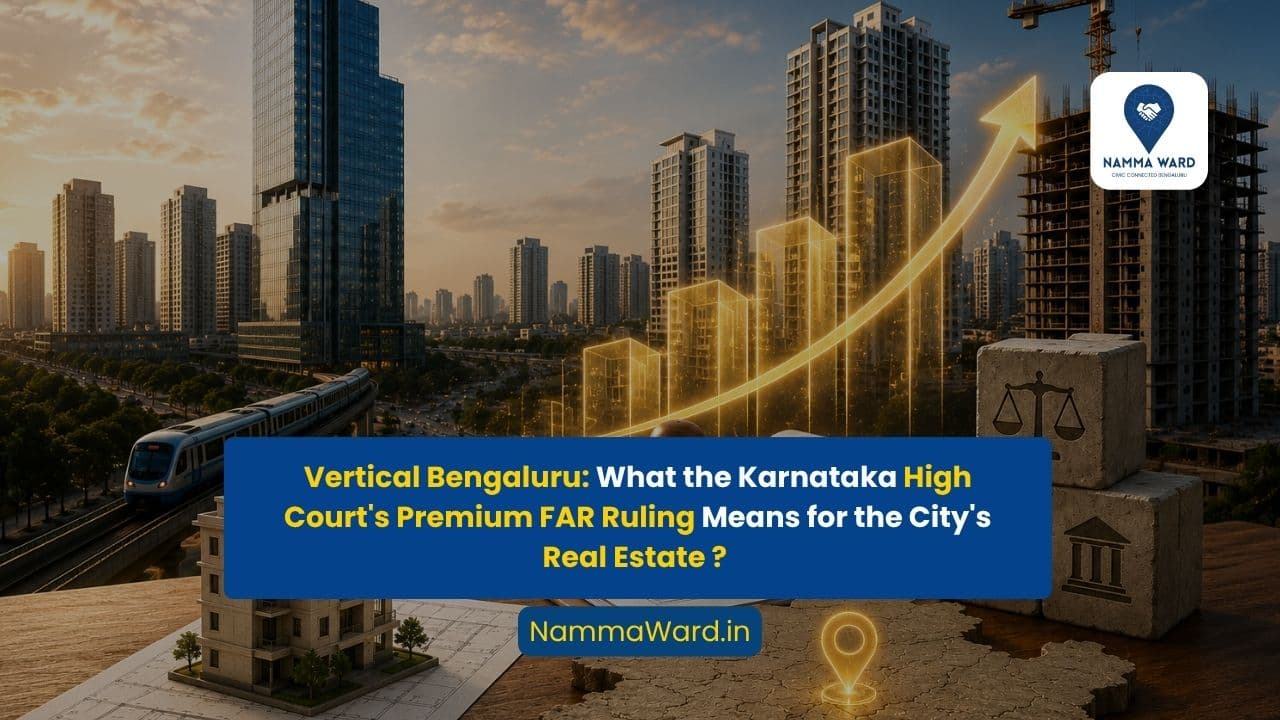
Vertical Bengaluru: What the Karnataka High Court’s Premium FAR Ruling Means for the City’s Real Estate
A Division Bench upholds Bengaluru’s Premium FAR framework in full, clearing the legal path for the city to grow upward rather than outward.
By P Mirle – Advocate & Partner, India Law Practice
A Division Bench upholds Bengaluru’s Premium FAR framework in full, clearing the legal path for the city to grow upward rather than outward.
On 15 June 2026, a Division Bench of the Karnataka High Court, comprising Chief Justice Vibhu Bakhru and Justice C.M. Poonacha, upheld the constitutional and statutory validity of Bengaluru’s Premium FAR framework, dismissing every challenge in Writ Appeal No. 1983 of 2025 and two connected petitions. The ruling clears the way for the city to grow upward rather than outward.
THE VERDICT
UPHELD IN FULL
All nine challenges dismissed
Writ Appeal No. 1983 of 2025 · c/w W.P. 14959/2020 & 2807/2026

Karnataka HC – Premium FAR & TDR Judgement 15-06-2026
What Premium FAR actually is
Floor Area Ratio (FAR) is the multiplier that determines how much built-up area a plot can carry relative to its size. Premium FAR is the mechanism that lets an owner build over and above the ordinarily permitted FAR by paying a premium charge and obtaining the necessary sanctions.
The Court upheld the framework’s three pillars: Section 18-B of the KTCP Act, which empowers the authority to grant Premium FAR and fixes premium charges at not less than 50% of the land-value uplift; Rule 37-E of the Planning Authority Rules, which prescribes how charges are calculated; and the 2026 government notifications that operationalise the scheme.
The mechanism governs which plots actually benefit. Additional FAR is capped at 0.6 times the base FAR, and the route to it turns on the width of the road a plot faces, so eligibility is neither uniform nor automatic across the city.
HOW ADDITIONAL FAR IS UNLOCKED
Road width abutting the plotSource of the extra areaMaximum additional FAR9 to 12 metresTDR only0.6 × base FAR12 metres and abovePremium FAR + TDR (combination)0.6 × base FAR
A judgement that decides nine things at once
The bench worked through nine distinct challenges, constitutional, statutory and administrative, and rejected each, amounting to a comprehensive validation of the framework rather than a narrow win. The full reasoning is set out in the judgment uploaded with this article; the essentials are below.
NINE CHALLENGES, NINE DISMISSALS
#The challengeWhy the Court rejected it1Article 300A: taking of propertyArt. 300A does not guarantee an asset’s market value; a cheaper lawful route to build is not expropriation.2Excessive delegation (Sec 18-B)Statute sets the policy and the ≥50% charge floor; rules supply the detail. No legislative function abdicated.3Notifications vs Section 18-BFound consistent with the parent section.4Rule 37-E vs the notificationsNo conflict in how premium charges are calculated and collected.5Scheme disregards TDR (Sec 14-B)TDR rules set only a maximum; a Premium FAR + TDR mix creates no inconsistency.6Article 21: density harms lifeJudicial review is not merits review; no evidence higher FAR degrades life. Bengaluru’s FAR is among the lowest anywhere.7Akrama Sakrama by another namePermitting new construction ≠ regularising illegal building. The substrata differ completely.8Article 243ZE: no MPC consultationPremium FAR is not the metropolitan ‘development plan’ that needs committee consultation.9Section 38-D of the BDA ActThe power is neither unbridled nor uncanalised, and not arbitrary.
Why this reshapes the market
By giving legal certainty that built-up area can be manufactured through Premium FAR rather than only acquired as land, the judgment tilts project feasibility toward a vertical, density-driven model.
DEMANDSUPPLYTDR MARKETParcels on wider roads gain value as eligibility tracks road width and zoning. Redevelopment and joint-development deals gain appeal, and investors price development potential, not just land extent.Built-up space can expand without fresh land, but unevenly, gated by road width, zoning, sanctioned-plan approval, infrastructure and code compliance. Permission to apply, not a windfall.It does not disappear, and maximising FAR may still need a Premium FAR + TDR mix, but it turns more market-sensitive. Even where it depresses TDR values, that is a market effect, not a deprivation.
A caution for buyers
“Premium FAR potential” is becoming a marketing phrase, and potential is not approval. Before buying, verify each of the following:
VERIFY BEFORE YOU BUY
- Premium FAR is sanctioned in the approved building plan
- Premium charges have actually been paid to the authority
- The extra built-up area appears in the sanctioned plan, not just a brochure
- RERA disclosures and the occupancy / commencement certificate position
- Parking allocation, common-area computation and zoning conformity
Title due diligence now has a new chapter: reviewing a property increasingly means examining FAR, Premium FAR eligibility, any TDR already loaded, and the plot’s true sanctioned development potential.
The planning question the judgment leaves open
The Court upheld the legality of Premium FAR; it did not licence unregulated growth. Higher density without matching infrastructure strains roads, water, sewage and traffic, and authorities must still grant Premium FAR only after genuine scrutiny. Vertical growth is now legally available; whether it is well-governed is a separate test the city must pass case by case.
The bottom line
For developers it improves project economics; for landowners it strengthens joint-development leverage; for investors it makes development potential as important as land area; for buyers it raises the premium on verification. For Bengaluru, it nudges the market toward a higher-density, approval-driven, vertical model, provided the authorities hold the line on planning and infrastructure. The Court has given the city legal permission to grow up; making that growth liveable now falls to everyone else.
WHAT THE RULING MEANS, BY STAKEHOLDER
StakeholderWhat changesDevelopersBetter project economics on eligible plots, with more saleable area and no fresh land to buy.LandownersA stronger hand in joint-development talks and better monetisation routes.InvestorsDevelopment potential, including road width, zoning and FAR eligibility, now matters as much as land area.BuyersA higher premium on verification: confirm Premium FAR is sanctioned and paid, not just marketed.BengaluruA nudge toward a higher-density, approval-driven, vertical model, provided infrastructure keeps pace.
Case reference: Krishnamurthy N v. State of Karnataka & Ors., Writ Appeal No. 1983 of 2025 (c/w W.P. No. 14959 of 2020 and W.P. No. 2807 of 2026), High Court of Karnataka, decided 15 June 2026. This article is a general explainer and not legal advice; readers should consult a qualified advocate on any specific transaction.