India’s Four Labour Codes: What They Mean for Workers, Employers and the Gig Economy
A plain-language guide to what India’s four new labour codes are, what changed, and who is affected.
By P Mirle – Advocate & Partner, India Law Practice
A plain-language guide to what India’s four new labour codes are, what changed, and who is affected.
WHAT CHANGED
29 laws become four codes
The biggest overhaul of Indian employment law in seven decades
Karnataka State Gazette, 22 June 2026 – Codes effective 21 November 2025
**29 → 4
Laws folded into codes50%
Minimum basic share of pay2 days
To settle final dues7.7M → 23M
Gig workers covered, by 203012 hrs
**Max shift, four-day week
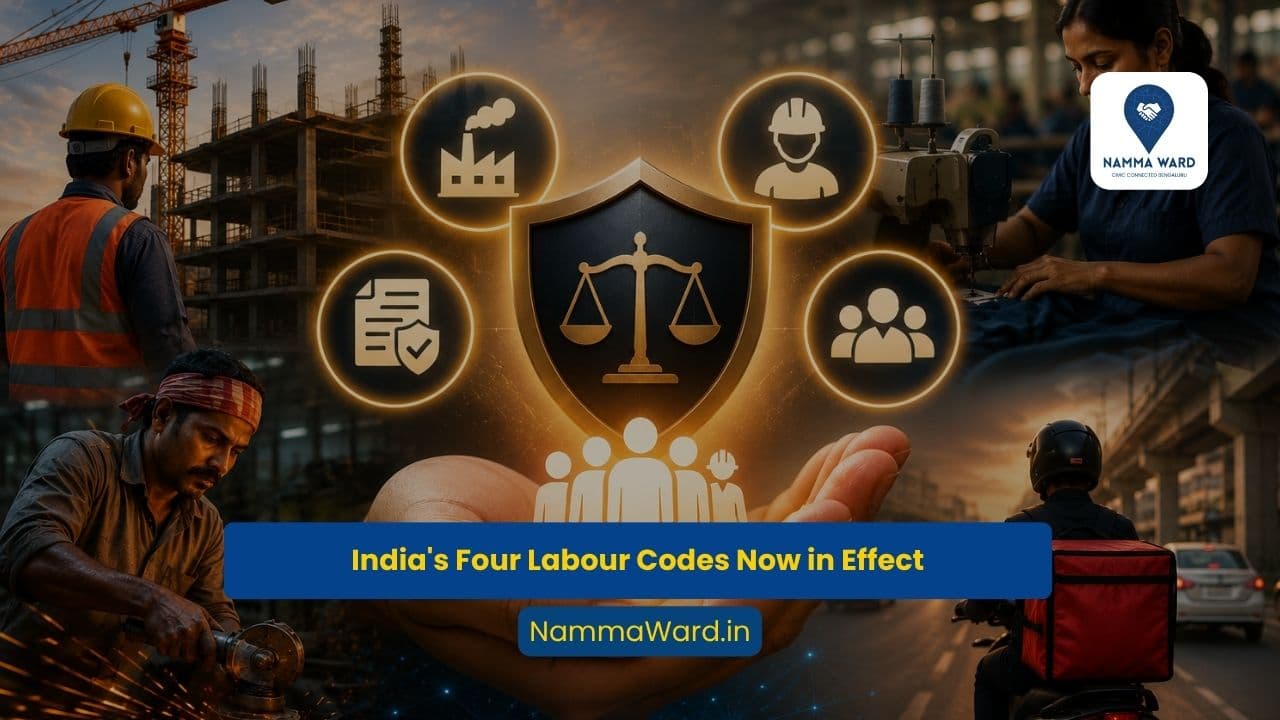
For the first time since Independence, India has rewritten the rulebook that governs how people are hired, paid, kept safe and looked after at work. Twenty-nine separate labour laws, some dating back to the 1920s, have been folded into four consolidated codes. The Karnataka State Gazette dated 22 June 2026 reproduced the four central rule sets that put these codes into operation, and together they touch nearly every working person in the country.
The big picture
The four codes are the Code on Wages (2019), the Industrial Relations Code (2020), the Code on Social Security (2020), and the Occupational Safety, Health and Working Conditions Code (2020). The codes themselves were notified as effective on 21 November 2025, in what was the largest single-day repeal of central labour statutes in independent India’s history. The central rules, the detailed machinery that makes the codes workable, followed, with the final versions notified on 8 May 2026 (the very notifications carried in this gazette).
Because labour is a “concurrent” subject under the Constitution, both the central government and each state must issue rules. That is why full enforcement has rolled out unevenly: several states had notified their final rules by mid-2026, while others were still working through drafts.
#CodeWhat it governs1Code on Wages (2019)Pay, minimum and floor wages, timely final settlement2Industrial Relations Code (2020)Unions, standing orders, disputes, retrenchment3Code on Social Security (2020)PF, ESI, gratuity, gig and platform workers4Occupational Safety, Health & Working Conditions (2020)Working hours, welfare, safety, appointment letters
1. The Code on Wages: the change that hits almost every payslip
This is the code with the broadest reach, because it redefines what counts as “wages.” Under the new definition, basic pay and a few core components must make up at least half of total compensation. For decades, many Indian salary structures, especially in IT and white-collar roles, leaned heavily on allowances to keep basic pay low, which in turn kept provident fund and gratuity contributions low.
THE PRACTICAL EFFECTS
- Take-home pay may dip slightly for allowance-heavy salary structures, because more of the salary now counts toward statutory deductions. Early industry commentary suggested a few percentage points of reduction in monthly take-home for many IT employees as employers rebalance pay packets.
- Provident fund and gratuity grow, since they are calculated on the larger wage base. Less cash today, more retirement and exit benefits tomorrow.
- A statutory floor wage applies across India, below which no employer may pay, alongside state-set minimum wages.
- Faster final settlements: wages owed when someone leaves, through resignation, termination or retrenchment, must be settled within two working days, replacing the old practice of waiting for the next payroll cycle.
The Ministry of Labour issued clarifying FAQs in March 2026 confirming, among other things, that overtime is counted within the 50% wage calculation and that annual performance bonuses are not treated as “wages” for statutory purposes.
2. The Industrial Relations Code: unions, disputes and retrenchment
This code governs the relationship between employers and workers: trade unions, standing orders, strikes, layoffs and dispute resolution. It applies in full and introduces several structural features:
- Model Standing Orders that employers can adopt for the mining, manufacturing and service sectors.
- A worker re-skilling fund: when a worker is retrenched, the employer must transfer an amount equal to 15 days of the worker’s last-drawn wages into a designated account, which can then be passed to the worker to support re-skilling.
- Grievance and negotiation machinery, including grievance committees and recognised negotiating unions, to formalise how disputes are raised and resolved.
The aim is a more predictable process for both sides: clearer rules for raising disputes, and clearer obligations when jobs are cut.
3. The Code on Social Security: the gig economy’s first safety net
This is arguably the most socially significant change. For the first time in India’s history, gig workers and platform workers, the people who drive for cab aggregators, deliver food, or pick up freelance work through apps, are brought formally within the social security framework.
KEY ELEMENTS
- Aggregators must contribute to a Social Security Fund for their workers, which can fund health benefits, disability cover, maternity support and old-age provision.
- Coverage extends to unorganised workers generally, not just the formally employed.
- Digital registration through a centralised portal, with a Universal Account Number issued to registered workers.
India’s gig workforce was estimated at roughly 7.7 million and is projected to grow to over 23 million by 2030, so the long-term reach of this provision is substantial. The exact contribution rates for gig work were expected through a separate central notification.
The code also carries forward and modernises familiar benefits, provident fund, employees’ state insurance, gratuity and maternity benefit, with a transitional, hybrid method for calculating gratuity that straddles the old and new wage definitions.
4. The Occupational Safety, Health and Working Conditions Code: the workplace itself
This code consolidates the rules on how workplaces must operate, from factories and mines to docks, plantations and construction sites. It is also where the most talked-about flexibility lives:
- Flexible working hours: employers can offer a four-day week with longer (up to 12-hour) shifts, subject to employee consent, as long as the 48-hour weekly cap holds. Overtime beyond the limits is payable at double the regular rate.
- Mandatory welfare provisions: annual health check-ups, crèche facilities, canteens and proper sanitation are required above certain thresholds, with specific provisions for women, transgender persons and persons with disabilities.
- Appointment letters for all: every employee must be issued a formal appointment letter, a meaningful change for informal and contract workers.
- A higher contract-labour threshold, raised from 20 to 50 workers, easing the compliance load on smaller operations.
Who should pay attention
WhoWhat it means for themSalaried employeesPayslips restructured: slightly lower take-home in many cases, higher long-term savings.Gig and platform workersFormal benefits and rights for the first time.Factory, mine and construction workersStrengthened safety, health and welfare protections.Employers and HR teamsThe heaviest near-term burden: restructuring pay, recalculating contributions, automating fast final settlements, and tracking state-by-state rules.
The bottom line
Taken together, the four codes represent the most consequential overhaul of Indian employment law in seven decades. The direction is consistent: simpler compliance for businesses, a wider safety net for workers, especially the gig economy, and a gradual shift in pay structures toward more secure long-term benefits. The remaining uncertainty lies in the patchwork of state rules and the fine print of forthcoming notifications, which will determine exactly how and when these changes land for any given worker.
Based on the Karnataka State Gazette notifications dated 22 June 2026 (central rules under the four labour codes) and contemporaneous reporting and government guidance as of mid-2026. Specifics, including contribution rates and state-level timelines, were still being finalised and may have changed since. For decisions affecting your own employment or business, consult the official Ministry of Labour and Employment resources at labour.gov.in or a qualified labour-law professional.