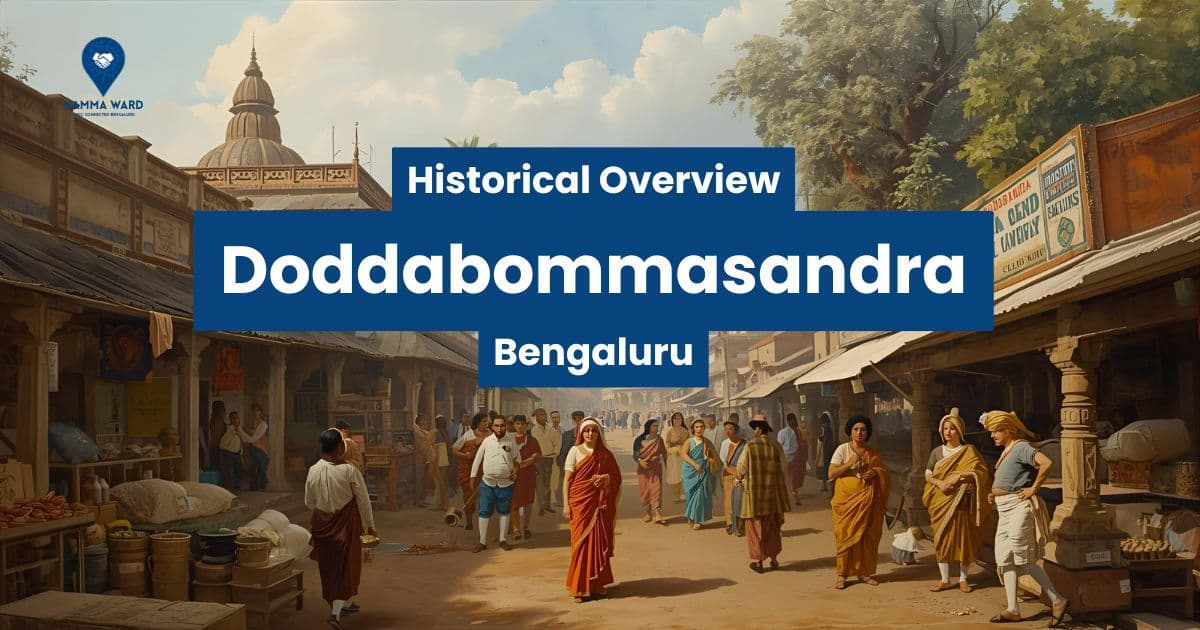
Historical Overview of Doddabommasandra, Bengaluru
Explore the fascinating history of Doddabommasandra, Bengaluru, from its Vijayanagara-era roots and ancient lake to its vibrant temples, diverse communities, and modern civic transformation.
Quick Summary
Doddabommasandra, located in North Bengaluru’s Yelahanka zone, has a fascinating journey that mirrors the city’s own transformation. From a small medieval settlement recorded in Vijayanagara inscriptions to a bustling residential ward today, the locality has seen centuries of cultural, demographic, and infrastructural evolution. Its historic lake, temples, and vibrant community life make it a unique blend of old-world charm and modern urban living.
Early History and Origins
Doddabommasandra’s story stretches back several centuries, rooted in the historic Kodigehalli region of North Bengaluru. Archaeological and inscriptional evidence places its origins between the 14th and 16th centuries CE, during the time of the Vijayanagara Empire.
A significant 15th-century Kannada inscription, discovered within the area, records a grant by a local chieftain named Bukka-Nayaka, who donated the village of “Bommahalli” to a Brahmin settlement (agrahara). This confirms that Doddabommasandra was recognized as an established settlement in medieval times, possibly known then as Bommasandra or Bommahalli.
The name Doddabommasandra itself carries linguistic and cultural weight. Derived from the Kannada words “dodda” (big) and “sandra” (lake or tank), it translates to “Big Bommasandra,” likely distinguishing it from a smaller settlement nearby.
Local folklore adds a spiritual dimension, many believe the area was named after a revered village deity or goddess, hinting at the presence of an early shrine that continues to define the community’s identity even today.
Development During the Colonial Era
During the British colonial period (19th to early 20th century), Doddabommasandra remained a quiet agricultural village on the outskirts of Bangalore. It came under the Bangalore Taluk administration within the Princely State of Mysore, indirectly governed by the British.
Life revolved around farming and the large Doddabommasandra Lake, an approximately 300-year-old man-made reservoir that sustained agriculture through an intricate system of canals. The lake was the lifeline of the local economy, supporting paddy fields and groves.
Although British influence grew in the larger city — through the establishment of the cantonment, railways, and infrastructure — Doddabommasandra remained largely untouched by urbanization. Until the 1940s, it retained its rural essence, marked by farmlands, traditional homes, and community temples.
Post-Independence Urban Growth and Infrastructure
The transformation began after India’s independence in 1947, as Bengaluru started expanding beyond its core. The founding of major public-sector industries nearby played a decisive role.
In 1954, the establishment of Bharat Electronics Limited (BEL) in Jalahalli became a turning point. It drew workers, engineers, and families, sparking housing development in and around Doddabommasandra. Other nearby institutions like Hindustan Machine Tools (HMT) in Yeshwanthpur accelerated this shift from rural to urban.
By the 1970s and 1980s, farmland gave way to plotted layouts, residential colonies, and public amenities. The once-sleepy village became part of Bengaluru’s growing suburban fabric.
In the decades that followed, connectivity improved dramatically:
- New BEL Road and Bellary Road (NH 44) linked the area to the city core.
- BMTC bus routes connected residents to major hubs like Yeshwanthpur and Vidyaranyapura.
- Railway halts at Lottegollahalli and Goraguntepalya enhanced commuter mobility.
- Metro connectivity arrived nearby through Yeshwanthpur and Peenya stations.
- The Kempegowda International Airport became accessible within 30 km via upgraded highways.
By the early 21st century, Doddabommasandra had become a well-connected, sought-after residential neighborhood, blending urban convenience with pockets of natural greenery around its historic lake.
Demographic Changes Over the Decades
From a few thousand agrarian residents in the 1980s to a bustling population of over 36,000 by 2011, Doddabommasandra’s demographic transformation has been striking.
Originally home to Kannada-speaking farming families, the area diversified as professionals, PSU employees, and migrants from across India moved in. By the 2000s, Doddabommasandra had evolved into a cosmopolitan microcosm of Bengaluru, where multiple languages — Kannada, Hindi, Telugu, Tamil, Tulu, and more — coexist harmoniously.
Today, the community includes:
- Original local families
- PSU and defense employees (especially from BEL and HMT)
- Professionals working in Manyata Tech Park and Kirloskar Business Park
- Students from nearby colleges
Despite its diversity, community bonds remain strong, strengthened through festivals, neighborhood initiatives, and lake conservation efforts — a testament to Bengaluru’s famed “unity in diversity.”
Cultural and Religious Significance
Doddabommasandra’s spiritual fabric runs deep, anchored by its ancient temples and folk traditions that have withstood urban change.
Prominent temples include:
- Anjaneya Swamy Temple – dedicated to Lord Hanuman
- Basaveshwara Temple – reflecting the Lingayat and Shaivite traditions
- Venugopalaswamy Temple – vibrant during Krishna Janmashtami
- Chamundeshwari Temple – center of the annual Jatre festival
The Doddamma Devi Temple, believed to honor the locality’s guardian goddess, remains a deeply revered shrine. During festivals like Navaratri and Hanuman Jayanti, the temples host Annadhanam (community feasts), Rathotsavas (chariot processions), and cultural performances that bring residents together.
Besides Hindu temples, churches and mosques in the vicinity reflect Doddabommasandra’s inclusive spirit. Local Kannada cultural groups also organize music, theater, and literature events, preserving the area’s cultural richness amid urbanization.
Political Evolution and Civic Importance
Administratively, Doddabommasandra’s journey mirrors Bengaluru’s growth story.
Before 2007, the area was governed by the Byatarayanapura City Municipal Council (CMC). With the expansion of Bengaluru’s municipal boundaries, it was incorporated into the Bruhat Bengaluru Mahanagara Palike (BBMP) — officially becoming Ward No. 10 (Doddabommasandra) in 2009.
Today, the ward:
- Falls under the Byatarayanapura Assembly Constituency
- Is part of the Bangalore North Parliamentary Constituency
- Has an elected corporator representing it in BBMP
Since merging into BBMP, Doddabommasandra has benefited from improved roads, drainage systems, solid waste management, and lake rejuvenation projects.
One of its most celebrated civic efforts is the revival of Doddabommasandra Lake in the late 2010s. Spearheaded by citizen groups like Friends of Lakes, BBMP, and Bharat Electronics Limited (BEL) — which built a 10 MLD sewage treatment plant under CSR — the initiative transformed a polluted waterbody into a thriving ecological and community hub.
This successful collaboration among residents, government bodies, and corporates became a model for sustainable urban development in Bengaluru.
Legacy and the Road Ahead
From ancient inscriptions to smart-city infrastructure, Doddabommasandra’s journey encapsulates the evolution of Bengaluru itself. It is a neighborhood that honors its heritage while embracing modernity — where old temples stand beside new apartments, and community-led environmental action defines civic pride.
As part of the Namma Ward initiative, Doddabommasandra today represents:
- Cultural continuity through its temples and traditions
- Community resilience through civic participation
- Urban progress through planned infrastructure and connectivity
In essence, Doddabommasandra is not just a place on Bengaluru’s map — it is a living narrative of heritage, harmony, and hope.