BDA's Clarificatory Circular on Modified Building Plan Sanctions: Balancing Development Rights and Apartment Owners' Interests
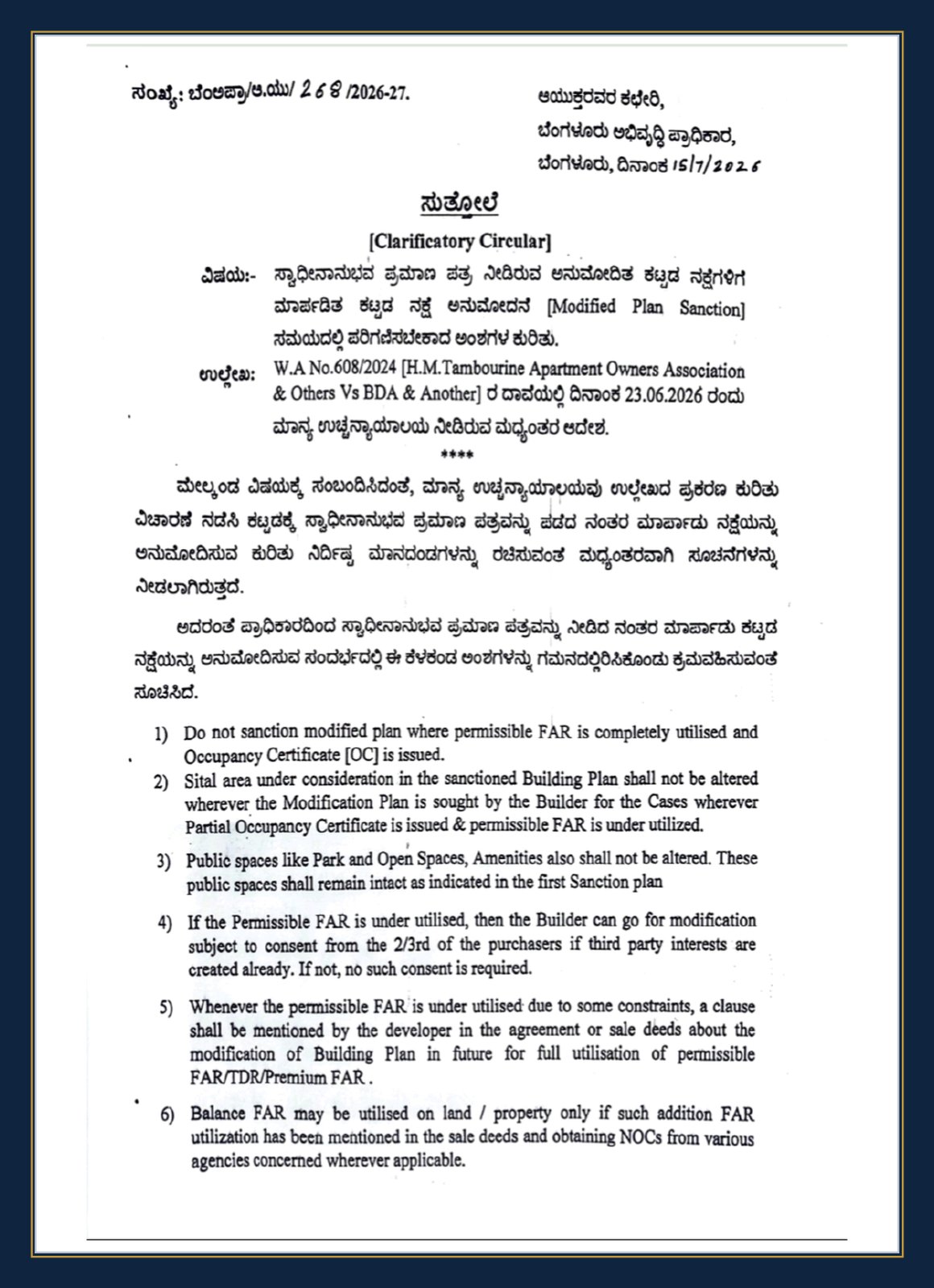
The BDA's Clarificatory Circular dated 15 July 2026, issued pursuant to the Karnataka High Court's judgment in W.A. No. 608/2024, settles when a developer may seek a modified building plan after apartments are sold — no modification once FAR is exhausted and OC issued, occupied portions and common areas protected, two-thirds purchaser consent required, and future FAR rights to be disclosed in sale documents. A legal analysis by Adv. V. Prashanth Mirle.
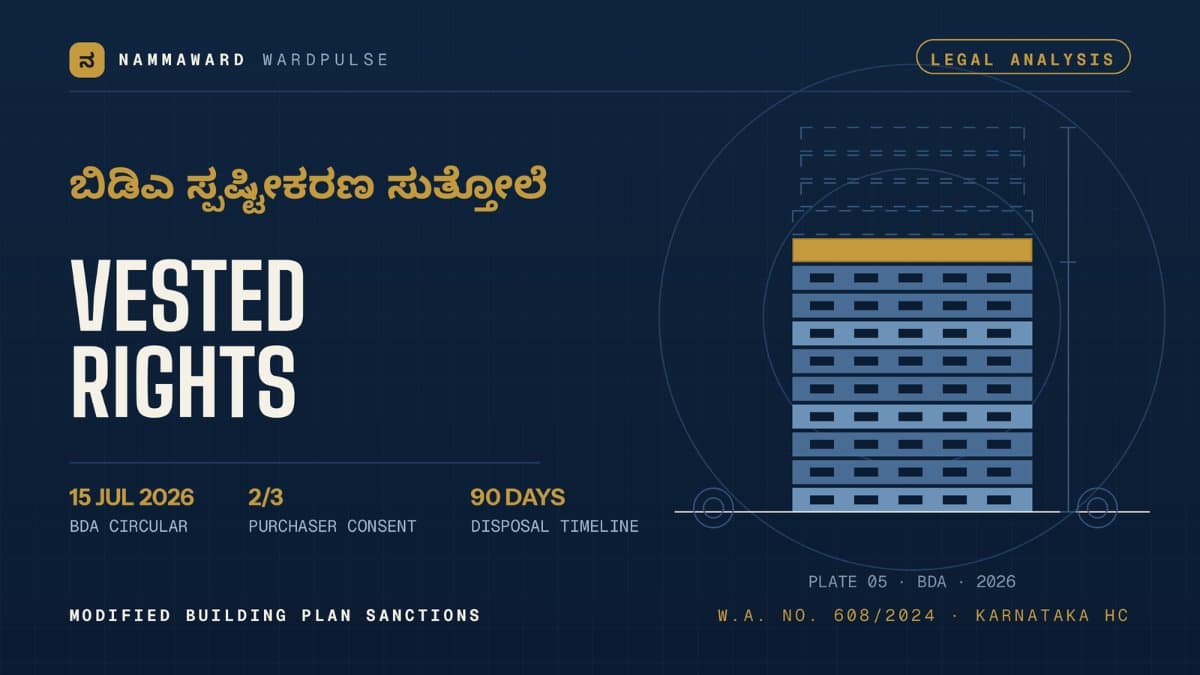
The BDA's 15 July circular redraws the line between a developer's right to build and a home-buyer's right to what was promised. Adv. V. Prashanth Mirle reads the fine print — what the circular settles, whom it protects, and the questions it leaves for the courts.
AT A GLANCE
- No modified plan once full FAR is used and the Occupancy Certificate is issued
- Portions with Partial OC cannot be touched; only the balance may be modified
- Parks, open spaces and amenities stay exactly as in the first sanctioned plan
- Two-thirds purchaser consent required where third-party rights exist
- Future FAR/TDR use must be disclosed in the Agreement to Sell / Sale Deed
- Existing owners' UDS cannot be diluted; 90-day disposal; ERP system from 1 April 2027
Bengaluru, 2 August 2026 — The Bangalore Development Authority (BDA), by its Clarificatory Circular dated 15 July 2026, has sought to settle one of the most contentious issues in urban development — the extent to which a developer may seek a Modified Building Plan Sanction after the original sanctioned plan has been approved and apartment units have been sold.
The circular has been issued pursuant to the judgment of the Hon'ble Karnataka High Court in W.A. No. 608/2024 (H.M. Tambourine Apartment Owners Association & Others v. BDA & Another) and lays down administrative guidelines governing the exercise of BDA's powers while considering applications for modified building plans.
THE HOLDING, IN ONE LINE: once apartments are sold, a sanctioned building plan is no longer merely a permission between the developer and the planning authority — it becomes a promise to the purchasers.
Although styled as a "clarification", the circular has significant implications for developers, apartment purchasers, resident welfare associations, lending institutions and planning authorities. It attempts to strike a careful balance between statutory development rights and the vested rights acquired by apartment purchasers.
ANALYSIS · PART I
The Issue Before BDA
In Bengaluru, it is not uncommon for developers to initially construct only a portion of the permissible Floor Area Ratio (FAR) and subsequently seek approval for additional construction by utilising the balance FAR, Transferable Development Rights (TDR) or Premium FAR.
This practice has often resulted in disputes where apartment owners contend that additional construction alters the very project they had invested in by reducing open spaces, affecting common amenities, increasing density or diminishing the enjoyment of the property. On the other hand, developers argue that the planning laws entitle them to utilise the entire permissible FAR unless expressly prohibited. The circular seeks to reconcile these competing interests by prescribing clear administrative principles.
ANALYSIS · PART II
A Significant Recognition of Vested Rights
Perhaps the most important aspect of the circular is its implicit recognition that once third-party rights are created through sale of apartments, the developer's freedom to alter the project is no longer absolute. Once purchasers acquire rights in the project, the sanctioned plan also assumes contractual and proprietary significance.
ANALYSIS · PART III
The Seven Key Directions
- No modification once development rights are exhausted. Where the permissible FAR has already been fully utilised and an Occupancy Certificate has been issued, no modified building plan shall be sanctioned. Once the project has attained completion, there remains no planning justification for reopening the sanctioned plan.
- Protection of occupied portions. Where a Partial Occupancy Certificate has been issued, the portion covered by it cannot be altered through a modified plan — only the balance portion of the development may be considered for modification.
- Common areas are not negotiable. Parks, open spaces and amenity areas shall not be altered and must remain exactly as reflected in the original sanctioned plan.
❝ Open spaces and common amenities are not merely planning requirements — they constitute valuable rights enjoyed collectively by apartment owners. ❞
- Consent of apartment purchasers. Where the developer seeks to utilise the balance permissible FAR after apartments have been sold, the circular mandates the consent of two-thirds of the purchasers wherever third-party rights have already been created.
- Transparency in sale transactions. Where the developer proposes to reserve the right to utilise balance FAR, TDR or Premium FAR in future, such intention must be expressly disclosed in the Agreement to Sell or Sale Deed. Purchasers and lending institutions would be well advised to scrutinise these provisions before completing transactions.
- Undivided Share cannot be diluted. Utilisation of additional FAR shall not alter the Undivided Share (UDS) of existing apartment owners — though practical questions of density, parking, infrastructure capacity and maintenance may still arise.
- Planning regulations frozen at original sanction. The zoning regulations applicable at the time of the original sanction continue to govern the modified plan; subsequently introduced regulations do not automatically apply.
ANALYSIS · PART IV
Administrative Reforms
The circular also directs digital integration between the concerned departments, implementation of an ERP-based approval system from 1 April 2027, and disposal of modification applications within 90 days. If effectively implemented, these measures could substantially reduce delays and improve transparency.
ANALYSIS · PART V
Questions That Remain
What constitutes "creation of third-party rights" for the purpose of requiring purchaser consent? Does two-thirds consent alone suffice where the declaration under the Karnataka Apartment Ownership Act or the Real Estate (Regulation and Development) Act imposes additional obligations? Can additional construction materially affecting ventilation, light, privacy or structural loading still be challenged notwithstanding compliance? And can purchasers who were never informed of future FAR utilisation in their sale documents challenge modified sanctions? These questions will inevitably fall for judicial determination in appropriate cases.
ANALYSIS · PART VI
Conclusion
The circular recognises that while a developer possesses statutory rights to utilise permissible development potential, those rights cannot be exercised in a manner that prejudices the proprietary and contractual rights already acquired by apartment purchasers.
For developers, the message is clear — future development rights must be planned and transparently disclosed from the outset. For apartment purchasers, the circular reinforces the importance of proper legal due diligence before purchasing a flat: examine the sanctioned building plan, the extent of FAR already utilised, and the contractual provisions governing any future utilisation of balance FAR, TDR or Premium FAR.
Ultimately, the true test of the circular will lie not in its wording but in its consistent implementation. If administered in its proper spirit, it has the potential to reduce avoidable disputes and foster greater confidence in Bengaluru's apartment housing sector.
ABOUT THE AUTHOR
Adv. V. Prashanth Mirle is an advocate practising in real estate and urban development laws in Bengaluru, and writes legal analyses for NammaWard WardPulse.
The full circular is attached below. This article is a general legal analysis and does not constitute legal advice.
ಕನ್ನಡ ಸಾರಾಂಶ
ಬೆಂಗಳೂರು ಅಭಿವೃದ್ಧಿ ಪ್ರಾಧಿಕಾರವು (ಬಿಡಿಎ) 15 ಜುಲೈ 2026ರ ಸ್ಪಷ್ಟೀಕರಣ ಸುತ್ತೋಲೆಯ ಮೂಲಕ, ಮೂಲ ನಕ್ಷೆ ಮಂಜೂರಾತಿಯ ನಂತರ ಫ್ಲಾಟ್ಗಳು ಮಾರಾಟವಾದ ಮೇಲೆ ಡೆವಲಪರ್ ಮಾರ್ಪಡಿಸಿದ ಕಟ್ಟಡ ನಕ್ಷೆ ಕೋರಬಹುದಾದ ಮಿತಿಗಳನ್ನು ನಿಗದಿಪಡಿಸಿದೆ; ಕರ್ನಾಟಕ ಹೈಕೋರ್ಟ್ನ W.A. No. 608/2024 ತೀರ್ಪಿನ ಅನುಸಾರ ಇದನ್ನು ಹೊರಡಿಸಲಾಗಿದೆ. ಅನುಮತಿತ FAR ಸಂಪೂರ್ಣ ಬಳಕೆಯಾಗಿ ಸ್ವಾಧೀನ ಪ್ರಮಾಣಪತ್ರ (OC) ನೀಡಿದ ನಂತರ ಯಾವುದೇ ಮಾರ್ಪಾಡು ನಕ್ಷೆ ಮಂಜೂರಾಗದು; ಭಾಗಶಃ OC ಪಡೆದ ಭಾಗವನ್ನು ಬದಲಾಯಿಸುವಂತಿಲ್ಲ. ಉದ್ಯಾನ, ತೆರೆದ ಸ್ಥಳ ಮತ್ತು ಸೌಲಭ್ಯ ಪ್ರದೇಶಗಳನ್ನು ಮೂಲ ಮಂಜೂರಾದ ನಕ್ಷೆಯಂತೆಯೇ ಉಳಿಸಬೇಕು. ಮೂರನೇ ವ್ಯಕ್ತಿಯ ಹಕ್ಕುಗಳು ಸೃಷ್ಟಿಯಾಗಿದ್ದಲ್ಲಿ ಬಾಕಿ FAR ಬಳಕೆಗೆ ಮೂರನೇ ಎರಡರಷ್ಟು ಖರೀದಿದಾರರ ಸಮ್ಮತಿ ಕಡ್ಡಾಯ; ಭವಿಷ್ಯದ FAR/TDR/ಪ್ರೀಮಿಯಂ FAR ಬಳಕೆಯ ಉದ್ದೇಶವನ್ನು ಕ್ರಯ ಒಪ್ಪಂದ ಅಥವಾ ಕ್ರಯಪತ್ರದಲ್ಲಿ ಸ್ಪಷ್ಟವಾಗಿ ನಮೂದಿಸಬೇಕು; ಹೆಚ್ಚುವರಿ FAR ಬಳಕೆಯಿಂದ ಈಗಿನ ಮಾಲೀಕರ ಅವಿಭಜಿತ ಪಾಲು (UDS) ಬದಲಾಗದು. ಮಾರ್ಪಾಡು ಅರ್ಜಿಗಳನ್ನು 90 ದಿನಗಳೊಳಗೆ ವಿಲೇವಾರಿ ಮಾಡಬೇಕು ಮತ್ತು 1 ಏಪ್ರಿಲ್ 2027ರಿಂದ ERP ಆಧಾರಿತ ಅನುಮೋದನಾ ವ್ಯವಸ್ಥೆ ಜಾರಿಯಾಗಲಿದೆ. ಫ್ಲಾಟ್ ಖರೀದಿಸುವ ಮುನ್ನ ಮಂಜೂರಾದ ನಕ್ಷೆ, ಬಳಕೆಯಾದ FAR ಪ್ರಮಾಣ ಹಾಗೂ ಒಪ್ಪಂದದ ಷರತ್ತುಗಳ ಕಾನೂನು ಪರಿಶೀಲನೆ ಅಗತ್ಯ ಎಂಬುದನ್ನು ಈ ಸುತ್ತೋಲೆ ಒತ್ತಿಹೇಳುತ್ತದೆ. — ವಕೀಲ ವಿ. ಪ್ರಶಾಂತ್ ಮಿರ್ಲೆ ಅವರ ವಿಶ್ಲೇಷಣೆ.